Vietnam War
The Vietnam War pitted communist North Vietnam and the Viet Cong against South Vietnam and the United States. The war ended when U.S. forces withdrew in 1973 and Vietnam unified under Communist control two years later.
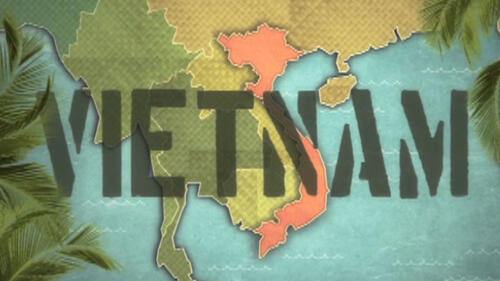

Start Here

A guide to the complex political and military issues involved in a war that would ultimately claim millions of lives.

The conflict in Vietnam took root during an independence movement against French colonial rule and evolved into a Cold War confrontation.

Gifted photographers and reporters captured images that conveyed the agony and violence of the Vietnam war, and the deep divisions it drove in American society.

The hippie counterculture reached its height during the escalation of U.S. involvement in Vietnam, and subsided as the conflict drew to a close.

3 Controversial Moments


My Lai Massacre
My Lai Massacre
In 1968, Ron Ridenhour, an infantryman in Vietnam, wrote a letter to President Nixon detailing the murder of 500 civillians by the U.S. Army in what would come to be known as the My Lai Massacre.
Explore All Related Topics

One real and one phantom firefight led the United States to engage more directly in the Vietnam War.

In August 1964, after two U.S. destroyers stationed in the Gulf of Tonkin were attacked by North Vietnamese forces, Congress passed the Gulf of Tonkin Resolution, which authorized President Johnson to take any measures he believed were necessary to retaliate. The resolution became the legal basis for the United States to enter the Vietnam War.

A guide to the complex political and military issues involved in a war that would ultimately claim millions of lives.

Check out six facts about this iconic testament to sacrifice and loss.

Who Was Daniel Ellsberg? In 1967, at the request of U.S. Secretary of Defense Robert McNamara, a team of analysts working for the Department of Defense prepared a highly classified study of the U.S. political and military involvement in Vietnam from the...

Vietnamization was a strategy that aimed to reduce American involvement in the Vietnam War by transferring all military responsibilities to South Vietnam.

The “Rainbow Herbicides” left a lethal legacy.

During the Vietnam War, the U.S military engaged in an aggressive program of chemical warfare codenamed Operation Ranch Hand.

The Vietnam War was a divisive conflict that pitted North Vietnam against South Vietnam and its principal ally, the United States.

A split-second act of peaceful defiance became one of the defining images of the Vietnam War era.

A weekend of escalating tensions exploded into 13 seconds of gunfire—and four dead in Ohio.

Their specialty: the military’s most sensitive—and unconventional—missions.

Air America flew passenger flights out of Taiwan in the mid-20th century. At the time, hardly anyone knew its true owner was the CIA.